
17
August
2026
Introduction
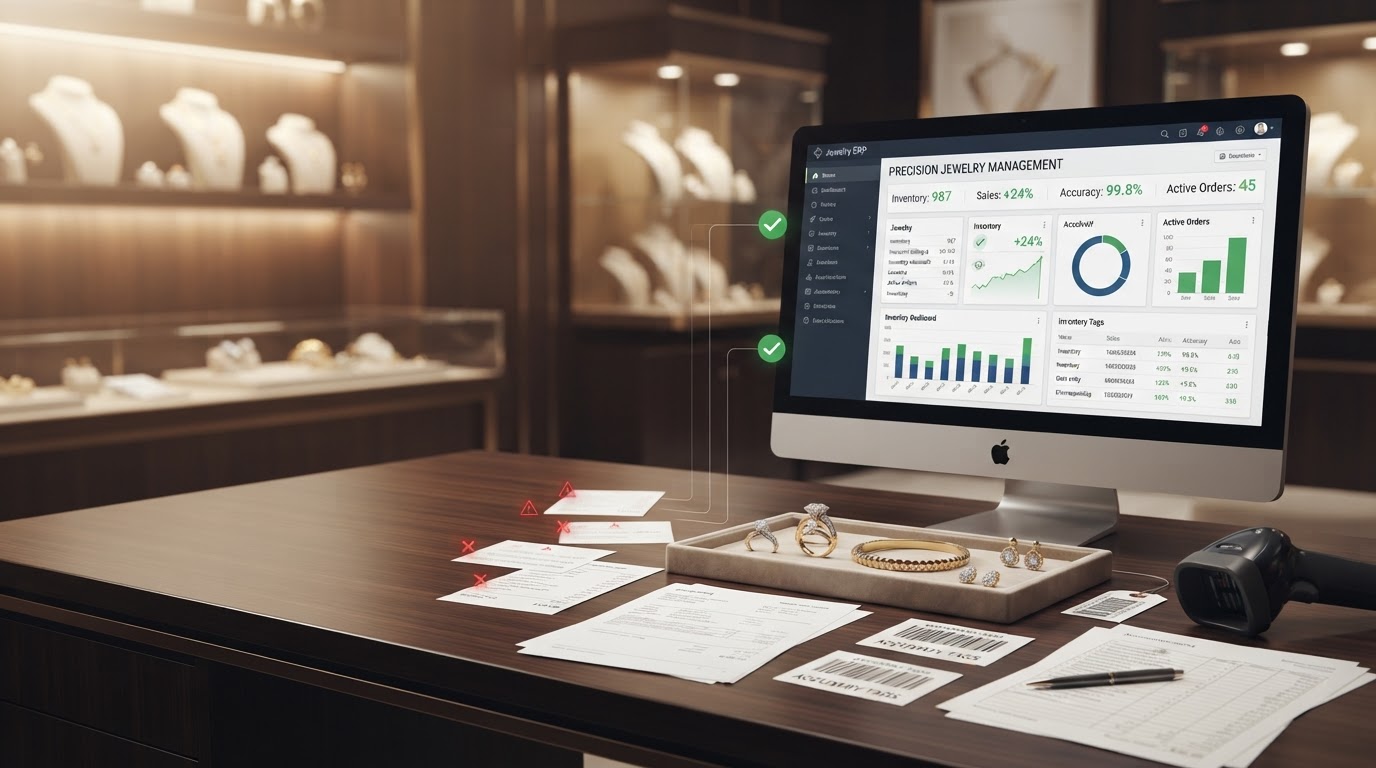
Running a jewellery business involves much more than selling beautiful products. From purchasing and inventory management to billing, customer relationships, accounting, and manufacturing, every stage needs accuracy. Even a small mistake in stock records or billing can create financial losses, customer complaints, and unnecessary operational work.
The good news is that most common jewellery business errors can be prevented with the right processes and technology.
In this guide, we’ll look at 10 common errors in the jewellery business, why they happen, and practical ways to avoid them. We’ll also explore how the right jewellery software can help jewellers improve accuracy, control inventory, simplify billing, and manage day-to-day operations more efficiently.
1. Poor Inventory Management
Inventory is one of the most important assets of a jewellery business. However, many jewellers still depend heavily on manual registers, spreadsheets, or disconnected systems to track stock. This can lead to:
- Incorrect stock quantities
- Missing ornaments
- Duplicate entries
- Difficulty tracking transfers
- Problems identifying slow-moving products
- Differences between physical and system stock
Because jewellery carries high value, even a small inventory discrepancy can have a significant financial impact.
How can it be avoided?
Use jewellery management software that provides real-time stock visibility. A good system should allow you to track items based on details such as product category, weight, purity, barcode, HUID, making charges, and location. Regular physical stock verification should also be part of your process.
2. Errors in Jewellery Billing
Billing mistakes are another common problem. Incorrect weight, making charges, discounts, taxes, or product details can quickly create disputes. For example, imagine a customer purchases a gold ornament and notices a difference between the quoted amount and the final invoice. Even if the mistake was accidental, it can affect their confidence in your business.
This is where reliable jewellery billing software becomes valuable. Modern billing systems can automate calculations and help reduce manual entry errors while maintaining consistent invoices.
Best practice
Before finalising a bill, ensure the system automatically calculates:
- Gold value
- Stone value
- Making charges
- Discounts
- GST
- Net amount
- Payment details
The more calculations you automate, the fewer opportunities there are for human error.
3. Not Tracking Jewellery Properly
A jewellery store can have thousands of individual products. Treating them simply as “gold stock” or “diamond stock” is not enough. Every ornament may have different specifications, including weight, purity, design, stone details, barcode, and HUID. Without proper tracking, locating a particular item can become unnecessarily difficult.
The solution
Choose software for jewellery businesses that provides item-level tracking. Barcode and QR-based identification can make stock searches faster and help employees locate products with greater accuracy.
4. Ignoring Customer Information
A customer buying a ₹5,000 accessory and a customer purchasing a ₹5 lakh bridal jewellery set should not be treated exactly the same way. Yet many businesses fail to maintain useful customer information.
Without proper customer records, it becomes difficult to understand:
- Purchase history
- Preferences
- Birthdays and anniversaries
- Outstanding payments
- Scheme participation
- Previous enquiries
A CRM-enabled jewellery ERP software can bring this information together. When customer information is organised properly, your team can provide more relevant communication instead of sending the same message to everyone.
5. Manual Accounting and Reconciliation
Jewellery businesses handle multiple payment methods, purchases, sales, returns, advances, schemes, expenses, and supplier transactions. When these activities are recorded manually across different systems, reconciliation becomes complicated.
The result can be: More manual work → more errors → more reconciliation → more time lost.
Integrated ERP software for jewellery industry operations can connect sales, inventory, accounting, and other business activities within one system. This gives management better visibility into the financial position of the business.
6. Poor Management of Gold Schemes
Gold saving schemes can be an effective way to build long-term customer relationships. However, managing instalments, maturity values, customer records, and redemption manually can become challenging as the number of customers increases. A missed payment or incorrect scheme calculation can quickly lead to customer dissatisfaction.
How to avoid it?
Use jewellery management software with dedicated scheme management features. The system should help your team monitor:
- Customer enrolment
- Instalments
- Due dates
- Payments
- Maturity
- Redemption
- Scheme history
Automated reminders can also reduce the chance of missed follow-ups.
7. Lack of Multi-Store Visibility
As a jewellery business expands, managing multiple branches becomes increasingly difficult. One store may have excess stock while another needs the same category of products. If management does not have a clear picture of stock across locations, opportunities can be missed.
A cloud based jewellery ERP software solution can provide centralised visibility across branches. Management can monitor sales, stock, transfers, customer activity, and business performance without depending entirely on separate branch-level reports.
8. Not Paying Attention to HUID and Compliance
Compliance is becoming increasingly important for modern jewellery businesses. Manual entry of product and compliance information can increase the possibility of mistakes. For jewellers dealing with large volumes of products, maintaining accurate records is essential.
A suitable jewellery ERP system can help businesses manage HUID-related information and support compliance-oriented workflows. However, software should support your compliance process not replace professional accounting or regulatory advice.
9. Using Too Many Disconnected Tools
One of the biggest operational mistakes is using separate software for billing, accounting, inventory, customer management, and reporting without proper integration. Employees then spend time moving information from one system to another.
For example: Sale → Billing system → Spreadsheet → Accounting software → Manual report
Every additional manual step creates another opportunity for an error. An integrated jewellery ERP software solution brings core business functions together and creates a single source of information. That is one reason businesses looking for the best jewellery software should evaluate integration capabilities rather than focusing only on billing features.
10. Making Decisions Without Reliable Data
Perhaps the most expensive mistake is making business decisions based on assumptions.
Which products are selling? Which branch is performing best? Which customers are returning? Which stock is moving slowly? How much inventory is currently available?
Without accurate reports, these questions can take hours to answer or worse, lead to incorrect decisions. Modern Jewellery ERP Software solutions provide dashboards and reports that help business owners monitor important metrics and make decisions using current business data.
How Can Jewellery Businesses Reduce Errors?
Avoiding errors does not require complicated processes. Start with a few practical steps:
- Standardise your processes: Create clear procedures for purchasing, stock receiving, transfers, billing, returns, and payments.
- Reduce manual data entry: Whenever possible, use automation, barcode scanning, and integrated systems.
- Verify stock regularly: Conduct physical stock checks and compare them with system records.
- Train employees: Even the best system cannot prevent mistakes if employees do not know how to use it correctly.
- Use integrated technology: Instead of maintaining multiple disconnected tools, consider an erp software for jewellery industry that connects important operations.
- Monitor reports regularly: Do not wait until the end of the year to identify problems. Review inventory, sales, receivables, and other important reports regularly.
Conclusion
Jewellery businesses operate in an industry where accuracy matters at every step. A small billing error, an incorrect stock entry, or a missed customer follow-up can gradually become a much bigger business problem. The solution is not simply to work harder. It is to create smarter processes and use technology where it genuinely adds value.
Whether you are comparing the top 10 jewellery software in India, searching for the best jewellery software, or evaluating a complete manufacturing ERP for your jewellery operations, focus on one important question: Will the system help my business reduce errors while giving me better control and visibility?
For growing jewellers, an integrated jewellery management software platform such as Nebu ERP can bring billing, inventory, CRM, accounting, schemes, HUID, reporting, and other essential operations together. The goal is simple: fewer mistakes, better control, and more confident business decisions.
Frequently Asked Questions


Ready to weave your vision into digital reality
Let’s craft your digital masterpiece together
Get Started Free
Leave a Comment