
14
December
2025
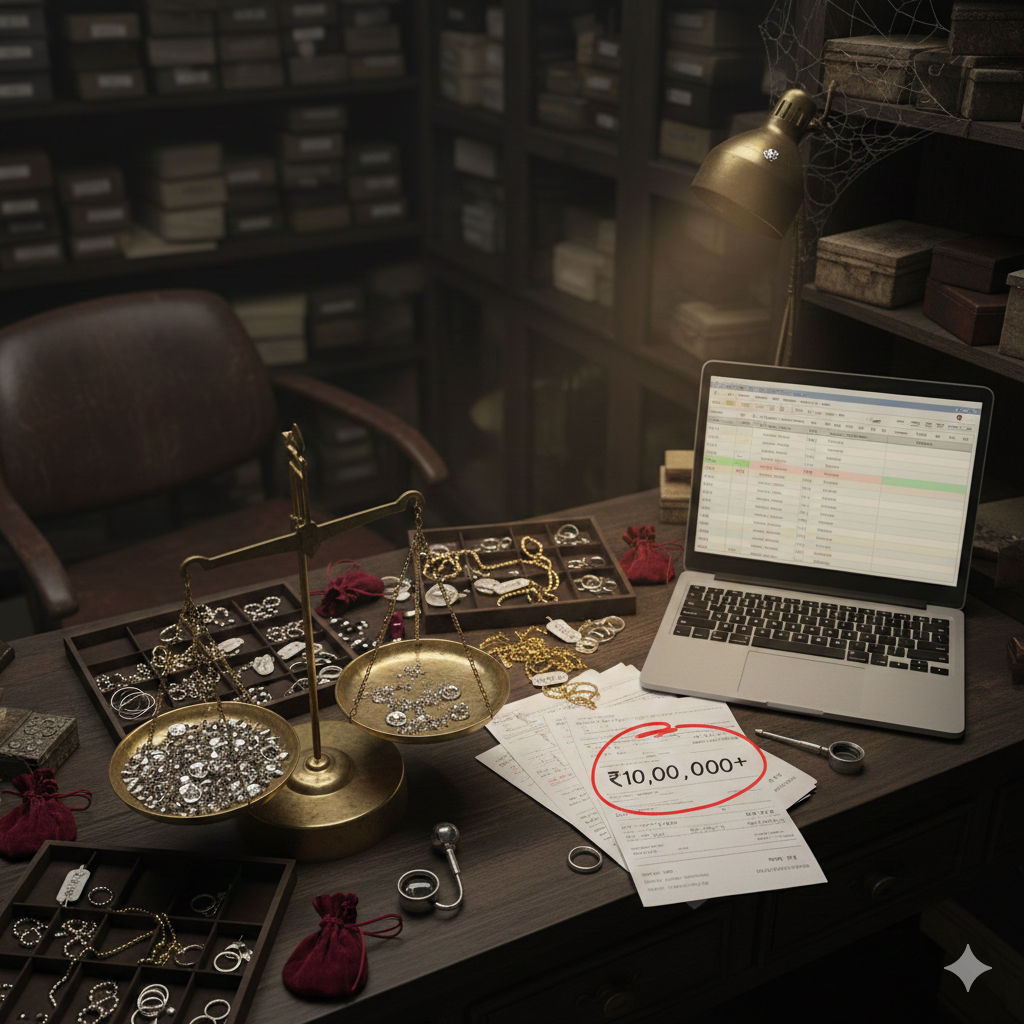
In a jewellery business, inventory is not just stock—it is money sitting on the shelf. A few milligrams here, a small purity difference there, or one missed entry during an exchange can slowly add up to losses worth lakhs. Most jewellers don’t notice this immediately. The impact usually shows up during audits, year-end accounts, or when profits don’t match expectations.
This blog looks at inventory mistakes from a real, day-to-day jewellery business perspective and explains why many of these issues happen—and how a well-structured jewellery ERP helps avoid them.
The Real Impact of Inventory Mistakes
Inventory problems rarely stay limited to the store room. They affect the entire business.
Financial Impact
When weights or values are slightly off, margins suffer. Incorrect closing stock directly affects profit figures, and over time, these small errors quietly turn into large financial losses.
Operational Impact
Sales teams face issues when system stock does not match physical stock. Billing slows down, managers spend time verifying numbers, and decisions are made using unreliable data.
Trust & Control Issues
Disputes during exchanges, uncertainty during audits, and lack of accountability internally all reduce confidence—both inside the team and with customers.
7 Inventory Mistakes Jewellery Businesses Commonly Make
1. Not Knowing the Exact Stock at Any Given Time
In many shops, inventory is updated after sales close or at the end of the day. With constant movements—sales, repairs, returns, and transfers—this creates gaps.
What goes wrong:
● System stock doesn’t match physical stock
● Wrong availability at the counter
● Missed or delayed sales
How ERP helps: A jewellery ERP updates inventory instantly, so stock figures are always current and reliable.
2. Tracking Items but Not Weights and Purity Properly
Counting pieces without accurately tracking gross weight, net weight, purity, and wastage is a common issue.
What goes wrong:
● Stock value becomes inaccurate
● Losses during melting or exchanges
● Confusion in accounts
How ERP helps: ERP records inventory weight-wise and purity-wise, with automatic calculations based on rates.
3. Making Manual Corrections Without Clear Records
Manual stock adjustments without proper records create serious control gaps.
What goes wrong:
● No clarity on who changed what
● Difficulty identifying mistakes or misuse
● Stress during audits
How ERP helps: ERP systems maintain audit trails, showing every change with user details and time stamps.
4. Losing Track of Repairs, Returns, and Exchanges
Inventory often goes missing not during sales, but during non-sales movements.
What goes wrong:
● Items stuck in repair status
● Delayed return entries
● Customer complaints
How ERP helps: ERP tracks each inward and outward movement separately, keeping inventory clear at every stage.
5. Managing Each Branch in Isolation
As businesses grow, managing inventory separately for each location becomes risky.
What goes wrong:
● Transfer mismatches
● Duplicate or missing entries
● Delays in decision-making
How ERP helps: With centralized, multi-store inventory control, ERP provides one clear view across all locations.
6. Delaying or Skipping Stock Reconciliation
Postponing stock verification allows small errors to grow unnoticed.
What goes wrong:
● Hidden losses
● Sudden year-end adjustments
● Audit pressure
How ERP helps: ERP makes reconciliation faster and simpler by matching physical stock with system records.
7. Keeping Inventory and Accounts Separate
When inventory and accounting don’t talk to each other, errors multiply.
What goes wrong:
● Incorrect profit calculations
● Wrong closing stock values
● Compliance challenges
How ERP helps: A jewellery ERP connects billing, inventory management, and accounting into one flow.
Why These Problems Continue
Most inventory issues are not due to negligence. They happen because of:
● Manual registers and spreadsheets
● Generic accounting software
● Lack of standardized processes
● No centralized system
Without the right tools, even experienced teams struggle to stay accurate.
ERP: From Control to Confidence
A jewellery ERP is not just about software—it brings discipline and clarity to daily operations. It helps manage:
● Billing and Accounting
● Inventory Management
● Customer Relationship Management (CRM)
● Multi-Store and Multi-Location Operations
● Schemes and Loyalty Programs
Together, these ensure inventory stays under control as the business grows.
What Changes After ERP Implementation
Jewellery businesses using ERP usually notice:
● Better visibility over stock
● Reduced inventory loss
● Smoother audits
● More confident decision-making
Inventory management shifts from constant checking to controlled monitoring.
Frequently Asked Questions
Is inventory loss unavoidable in jewellery businesses?
Small variations may occur, but large or repeated losses are often due to system gaps.
Can ERP really prevent stock misuse?
With controlled access and audit trails, ERP greatly reduces misuse and errors.
Is ERP useful for smaller jewellery shops?
Yes. It brings structure and clarity even for single-store operations.
Final Thoughts
Inventory mistakes rarely happen all at once. They build up quietly over time and surface when it’s already costly. Jewellery businesses that rely on manual or disconnected systems often lose money without realizing where it went.
A reliable jewellery ERP creates visibility, accountability, and peace of mind. Logiology offers ERP solutions built specifically for jewellery businesses, helping owners maintain accurate inventory, clean accounts, and steady growth.
Take control of your inventory and profits.
Book a demo with Logiology today.


Ready to weave your vision into digital reality
Let’s craft your digital masterpiece together
Get Started Free
Leave a Comment